
iGaming SEO Trends: Search Visibility, Content, and Player Acquisition
The integration of generative artificial intelligence into global search algorithms and the tightening of spam policies have fundamentally redefined the operational mechanics of iGaming SEO. For operators and affiliates, traditional volume-based content and automated link acquisition no longer guarantee SERP dominance. Success in the current highly regulated, algorithmically volatile environment requires shifting focus from raw keyword targeting toward verifiable topical authority, flawless technical foundations, and a conversion-centric approach to player acquisition.

AI Search and Changing Organic Click Patterns
How AI Overviews and AI Mode Affect iGaming Search Visibility
The rollout of AI Overviews (formerly SGE) by major search engines is actively cannibalizing zero-click informational searches. When a user queries “how to play blackjack” or “what is an accumulator bet,” search engines increasingly synthesize the answer directly at the top of the SERP, drastically reducing organic click-through rates (CTR) to publisher websites. For iGaming affiliates who previously relied on broad, top-of-the-funnel educational hubs to generate massive traffic volumes, this shift represents a direct threat to their top-line metrics.

However, AI models generally avoid synthesizing commercial or transactional queries within highly regulated sectors (YMYL—Your Money or Your Life). Queries like “best fast withdrawal crypto casino” or “live roulette sites UK” continue to yield traditional organic blue links, as search engines prefer to pass the liability of financial recommendations to third-party publishers. Consequently, search visibility strategies must aggressively pivot away from generic glossaries toward deep commercial investigation and specific platform reviews.
Tracking AI Citations, Organic Clicks, and Search Intent by Market
To adapt, SEO teams must track performance beyond traditional rank positions. Ranking number one for an informational query is useless if an AI Overview consumes 90% of the screen real estate and satisfies the user’s intent without a click.
| Search Intent | Example Query | AI SERP Impact | Strategic SEO Pivot |
| Informational | “Roulette rules” | High (AI synthesis directly answers query) | Deprioritize traffic; use only as supporting internal link silos. |
| Investigational | “Parimatch vs Melbet” | Medium (AI may summarize features) | Focus on dynamic comparison tables and proprietary testing data. |
| Transactional | “Parimatch app download 2026” | Low (AI defers to actual download pages) | Optimize for mobile conversion, precise localized keywords, and schema markup. |
Monitoring tools must now segment traffic by intent. Tracking systems must identify whether a drop in organic clicks is caused by a loss of rank, or because the query has been intercepted by a zero-click AI feature in a specific regional market.
Google Updates and Evolving Spam Policies
Understanding Core Updates and Ranking Volatility in Gambling Search
Google’s broad core updates continue to target the iGaming sector with intense scrutiny. These updates frequently decimate affiliate portfolios that rely on thin content, overlapping bonus pages, and manipulative exact-match anchor text. In recent rollouts, algorithms have heavily penalized domains exhibiting poor user experience metrics, such as intrusive interstitial pop-ups, slow-loading game iframes, and deceptive cloaking tactics.
Recovering from a core update in the gambling niche requires clinical, data-driven pruning. SEOs must conduct massive audits to identify and 301 redirect cannibalized pages, rewrite templated affiliate reviews, and submit aggressive disavow files to neutralize toxic link injections that frequently plague competitive gambling SERPs.

How Scaled Content and Site Reputation Abuse Policies Affect Affiliate SEO
Recent spam policy updates have explicitly targeted two widespread iGaming practices: scaled content abuse and site reputation abuse (often referred to as “Parasite SEO”).
Scaled content policies penalize sites that programmatically generate thousands of localized pages (e.g., spinning identical content for “Casino in London,” “Casino in Manchester”) offering zero unique value. Furthermore, site reputation abuse policies actively demote third-party iGaming subfolders hosted on high-authority mainstream news sites. Previously, an affiliate could rent a subfolder on a major regional newspaper (e.g., [news.com/betting](https://news.com/betting)) to immediately rank for highly competitive terms. Algorithms now increasingly segment these subfolders and strip them of the parent domain’s core authority, forcing affiliates to build genuine, standalone brand equity.
Original Research and Trust in Casino Reviews
Strengthening Reviews with First-Hand Testing and Transparent Rating Criteria
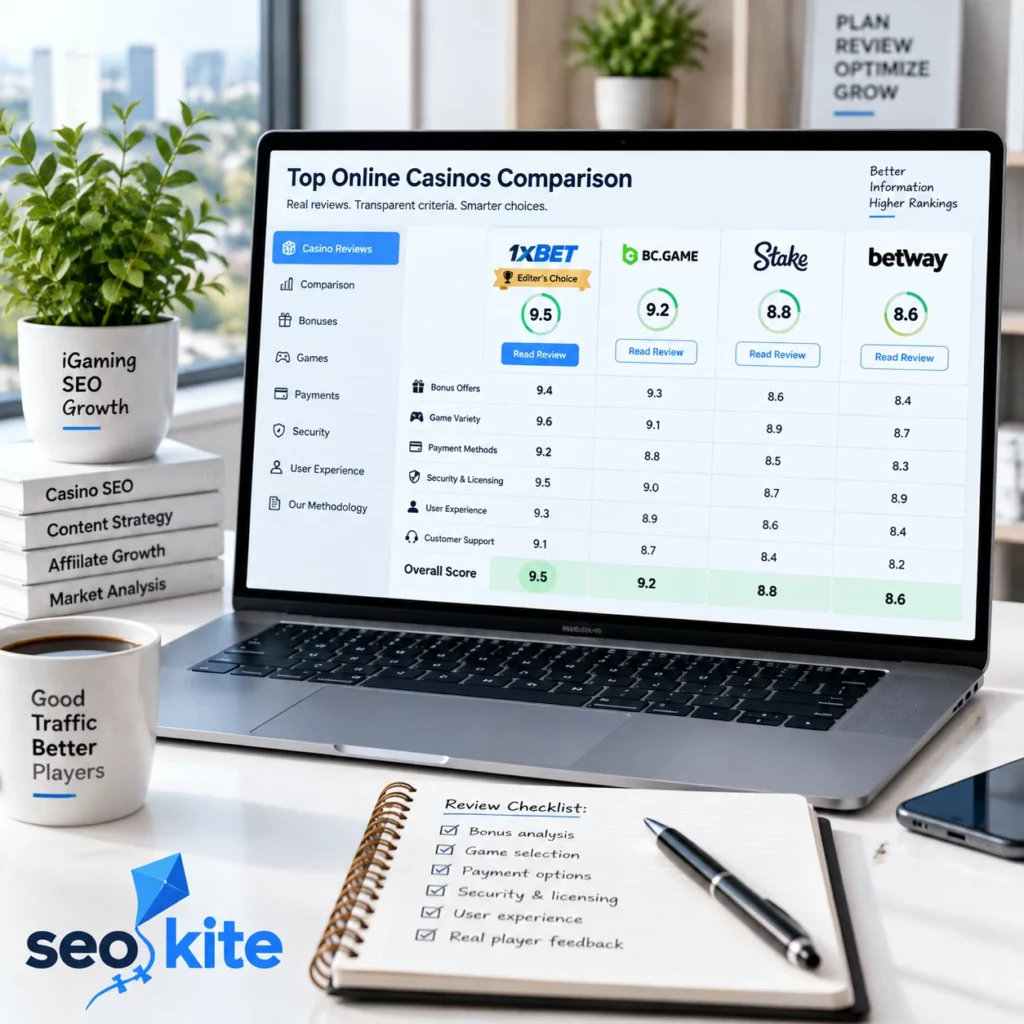
In response to E-E-A-T (Experience, Expertise, Authoritativeness, and Trustworthiness) requirements, generic praise in casino reviews is algorithmically obsolete. To rank commercial pages, publishers must inject irrefutable evidence of first-hand experience into their content.
To satisfy both users and search quality raters, a review must include the following trust signals:
Proprietary Screenshots
Original, timestamped images of the user dashboard, game lobbies, and KYC upload screens, avoiding promotional press kit images.
Documented Payout Testing
Exact timelines detailing a real-money deposit, a brief session of play, and the precise hour the withdrawal hit a specific localized e-wallet or bank account.
Explicit Editorial Standards
A dedicated methodology page linking from every review, explaining exactly how numerical ratings are calculated across distinct categories (e.g., game variety, support speed, bonus fairness).
Keeping Bonus Terms, Withdrawal Details, and Licence Information Verifiable
Trust is immediately broken when a user clicks an organic link expecting a specific bonus, only to find the offer expired or the terms misrepresented. Algorithms measure the resulting bounce rate and subsequent pogo-sticking (returning to the SERP to click another result) as a direct signal of low page quality.
Furthermore, legal compliance is a ranking factor in YMYL spaces. Pages must clearly display the operator’s corporate registration numbers, active gaming licenses, and links to responsible gambling organizations (e.g., BeGambleAware, GamCare). Implementing automated API feeds to pull live odds and currently active promotional codes directly into the HTML structure ensures that the content remains factually accurate without requiring constant manual editorial intervention.
Link Building Trends and Brand Authority
Earning Relevant Links Through Industry Research and Digital PR
As the efficacy of easily manipulated PBNs wanes, leading iGaming SEOs are reallocating budgets toward Digital PR and data journalism. Securing contextually relevant links from tier-one media outlets, regional sports portals, and financial publications provides the algorithmic armor necessary to withstand core updates.
Successful Digital PR campaigns in the gambling sector utilize proprietary data:
Sports Data Analysis
Publishing interactive maps or statistical models analyzing historical betting trends on major events, such as the Asian Games or regional football derbies.
Player Behavior Studies
Aggregating anonymized platform data to release whitepapers on the growth of specific deposit methods (e.g., cryptocurrency adoption rates in betting) or shifts in mobile gameplay.
Regulatory Coverage
Providing expert commentary to financial journalists regarding new taxation laws or licensing frameworks impacting specific geographical markets.
Reassessing PBNs, Paid Placements, and Expired Domain Strategies
While Private Blog Networks (PBNs) and expired domain redirects remain in use, their risk profile has escalated dramatically. Search algorithms are increasingly adept at identifying footprint overlaps, topical irrelevance, and unnatural outbound link velocities.
Redirecting an expired domain that previously hosted a local bakery directly to a sportsbook homepage passes zero contextual relevance and often triggers algorithmic suppression. Paid placements (guest posts) must be rigorously vetted. If a domain possesses high third-party metrics (DA/DR) but actively publishes unrelated articles about software development, health supplements, and casinos on the same day, acquiring a link there is a toxic investment. Authority development must prioritize strict topical relevance and editorial stringency over raw link volume.

Regional Market Changes and Localised SEO
How Gambling Regulation Reshapes Keyword and Content Opportunities
Global iGaming SEO is not a singular strategy; it is a collection of hyper-localized campaigns dictated entirely by regional regulations. A keyword strategy that succeeds in a grey market will fail completely in a newly regulated jurisdiction.
When a market introduces strict advertising frameworks (e.g., Ontario, Canada or various US states), broad keywords like “free spins” or “no deposit bonus” are often heavily restricted or completely banned by regulators. SEO strategies must immediately pivot from aggressive bonus promotion to compliance-focused content, targeting educational terms, software provider reviews, and app performance comparisons to capture traffic without violating advertising standards.
Adapting to Local Payment Methods, Betting Interests, and Search Language
Direct machine translation of a successful English campaign into Portuguese, French, or Uzbek guarantees failure. User intent is deeply tied to cultural betting habits and local financial infrastructure.
| Localization Element | Direct Translation Error | Strategic Localized Approach |
| Search Terminology | Translating “slot machines” directly across all Spanish markets. | Utilizing “tragaperras” for Spain and “tragamonedas” for LATAM markets. |
| Payment Gateways | Promoting PayPal universally on all localized pages. | Building dedicated review hubs for regional rails: Pix (Brazil), Interac (Canada), or local mobile money (Africa). |
| Content Focus | Translating generic horse racing guides globally. | Shifting focus to localized interests: eSports in Asia, specific football leagues in Europe, or regional reality TV betting. |
AI Automation and Content Quality at Scale
Automating Technical Monitoring and Content Update Alerts
Managing thousands of localized pages, dynamic odds feeds, and constantly changing promotional URLs requires aggressive technical automation. Human SEO managers cannot manually identify when a staging environment push accidentally applies noindex tags to the core commercial hub.
Advanced teams utilize Python scripts and API integrations to automate critical diagnostics:
Daily Log File Analysis
Automatically identifying if Googlebot is getting trapped in infinite parameter loops within the casino game filter architecture.
Uptime & Rendering Pings
Monitoring critical JavaScript rendering pathways; if a live game lobby fails to render its HTML payload to the crawler, automated alerts trigger the engineering team instantly.
Competitor Change Tracking
Tracking real-time modifications to competitor title tags or header hierarchies to identify when they adjust their semantic targeting ahead of major sporting events.
Maintaining Editorial Control Across AI-Assisted and Multilingual Pages

AI tools provide massive operational leverage for structuring content, but they introduce severe risks if published raw. Search algorithms can detect the repetitive syntax and factual hallucinations inherent in unprompted LLM generation.
The most effective workflow utilizes AI strictly for structural acceleration. AI models should be used to extract LSI keywords from competitor pages, programmatically draft hundreds of localized meta descriptions based on strict character limits, and generate standardized HTML frameworks (H2/H3 headers). However, a native-speaking human editor must execute the final pass, injecting brand voice, verifying regulatory compliance, and inserting proprietary testing data before publication.
Search Experience and Conversion Measurement
Combining Mobile-Friendly Comparisons with Clear Bonus and Payment Information
Mobile dominance in iGaming requires stripping away desktop-centric design philosophies. A mobile user executing a high-intent search (“fast payout casino app”) will bounce immediately if confronted with massive hero images or dense paragraphs of text.
The mobile search experience must prioritize immediate actionability. Above the fold, publishers should deploy horizontally scrollable comparison tables, large touch-friendly CTA buttons, and clear bullet points outlining the minimum deposit and wagering requirements. Slow loading times caused by unoptimized promotional banners or heavy third-party tracking scripts directly harm both Core Web Vitals rankings and bottom-line conversion rates.
Measuring Organic Performance Beyond Rankings: Registrations, FTDs, and Revenue
Vanity metrics—such as total organic sessions or holding the number one rank for a broad informational query—obscure the true financial impact of an SEO campaign. If a page generates 10,000 visitors but yields zero First Time Depositors, it is a commercial failure draining server resources.
SEO reporting must integrate directly with backend affiliate tracking and operator CRMs. Using advanced tag management and Postback URLs, teams must measure performance down to the individual landing page level, tracking:
Click-to-Registration Rate
How effectively the landing page convinces the user to initiate the signup process.
Registration-to-FTD Rate
The percentage of users who complete KYC and successfully deposit real funds.
Cost Per Acquisition (CPA) & Net Gaming Revenue (NGR)
Proving the exact financial ROI generated by organic search compared to paid media channels.
Frequently Asked Questions
Which iGaming SEO Trends Matter Most?
The most critical trends are the shift toward E-E-A-T and verifiable proprietary testing in content, the transition from manipulative link networks toward data-driven Digital PR, and the necessity of flawless technical rendering for JavaScript-heavy casino platforms. Relying on thin content and high-volume spam links is increasingly obsolete due to stricter algorithm updates.
How Is AI Search Affecting Casino and Betting Websites?
AI Overviews are cannibalizing traffic for broad, informational queries (e.g., “how to calculate odds”) by answering questions directly in the SERP. However, because AI defers financial liability, transactional queries (e.g., “best real money slots”) remain traditional blue links. Sites must pivot their efforts away from top-of-funnel glossaries toward bottom-of-funnel commercial reviews.
Does Google Penalise AI-Generated iGaming Content?
Google penalizes thin, unedited, and factually incorrect content, regardless of whether it is generated by AI or humans. However, raw AI text frequently lacks the specific expertise, proprietary testing evidence, and regulatory nuance required to satisfy YMYL standards. AI should be used for research, structuring, and metadata generation, while humans must handle final editorial quality control.
How Are Link Building Practices Changing in iGaming?
Algorithms are rapidly devaluing contextually irrelevant links and obvious PBN footprints. Link building is shifting toward Digital PR—producing original data studies, sports betting trend reports, and regulatory analysis to earn organic, highly authoritative citations from mainstream media and regional sports outlets.
How Do Regional Gambling Rules Affect SEO Opportunities?
Regulations dictate the entire keyword strategy. In strictly regulated markets, aggressive terms like “free cash” or “no deposit bonus” may violate advertising laws, forcing SEOs to target compliance-friendly terms, software reviews, and platform performance queries instead.
Which Metrics Show Whether iGaming SEO Traffic Converts?
Total traffic and keyword rankings are secondary. The ultimate indicators of successful iGaming SEO are the Click-Through Rate (CTR) on affiliate outbound links, the First Time Depositor (FTD) conversion rate, and the overall Net Gaming Revenue (NGR) mapped directly to specific organic landing pages.